
AIMA cuts migrant backlog
The Presidency Minister, António Leitão Amaro, said 458,989 residence cards have been issued, while INE prepares delayed foreign population figures for 22 June.

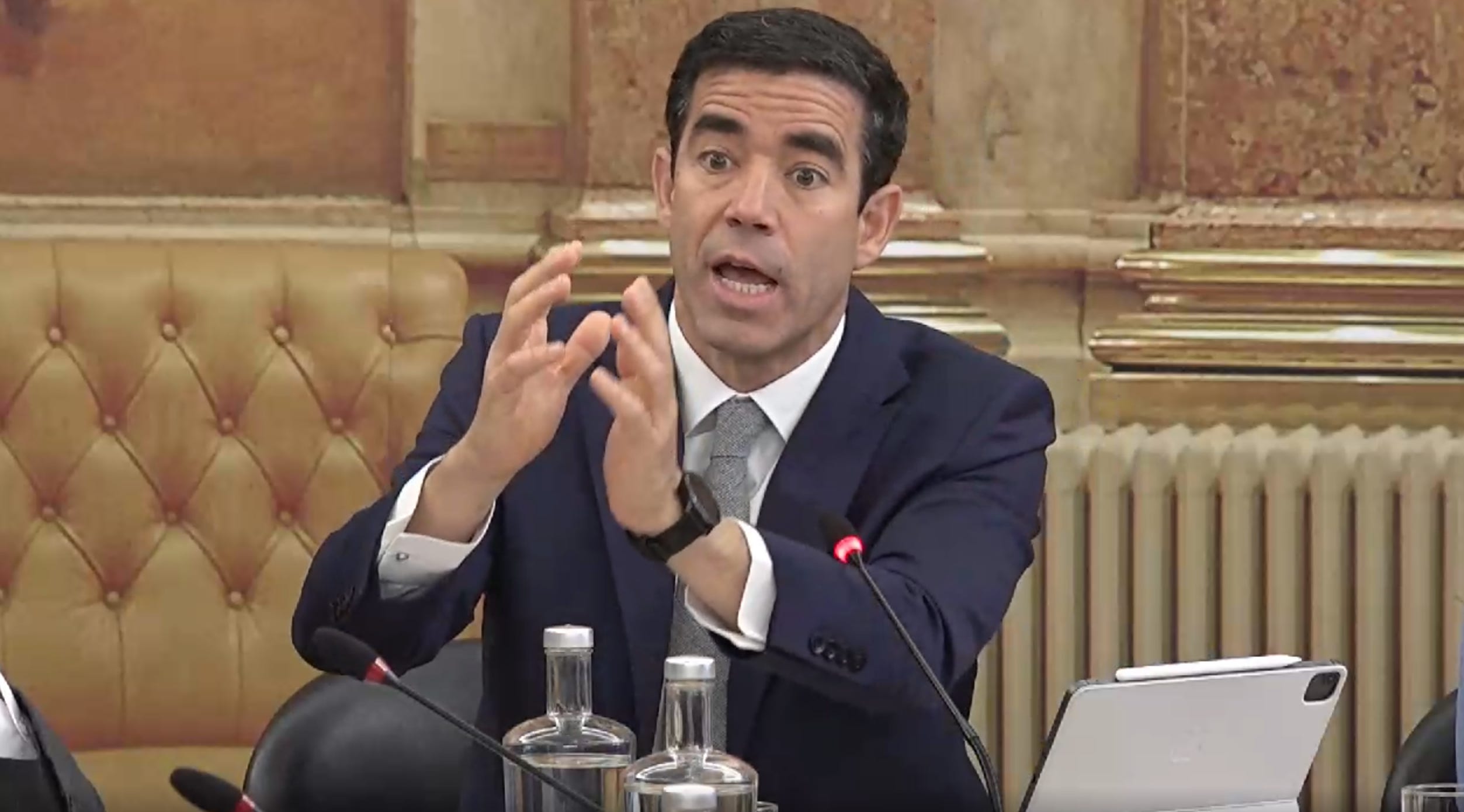
Minister of the Presidency António Leitão Amaro told Parliament this week that the Agency for Integration, Migration and Asylum (AIMA) and its mission unit have approved processes involving around 385,000 new immigrants in Portugal.
The minister described the work as “herculean” and said it had resolved thousands of pending regularisation cases that had been left inside the public administration.
“Imagine the smile on those people’s faces when they saw that card,” Leitão Amaro said, referring to the residence cards already delivered.
The figures were presented during a joint hearing of the parliamentary committees on Constitutional Affairs, Rights, Freedoms and Guarantees, and on State Reform and Local Government.
The hearing focused on discrepancies between AIMA data and figures from the National Statistics Institute (INE), whose updated data on foreign residents have been delayed.
Leitão Amaro detailed the backlog managed by the current and previous executives under the more restrictive migration policy presented on 3 June 2024.
According to the figures presented by the minister, around 385,000 foreign citizens entered the regularisation system for the first time and had their processes approved by the AIMA mission unit.
They were joined by 218,000 new immigrants processed by AIMA through its regular service and through judicial cases.
The services issued 933,000 notifications related to pending cases transferred to the mission unit.
Those notifications corresponded to 568,000 appointments involving unique individuals, the minister said in response to questions from the Socialist Party.
The services have taken 525,000 decisions, including 51,622 refusals.
A total of 458,000 residence cards have already been delivered to users, according to the figures first presented in Parliament.
In the more detailed figures later listed by the minister, the total number of cards issued was 458,989.
In the cases concerning new foreign residents who were already in Portugal at the beginning of June 2024, Lusa calculated that the mission unit approved 385,000 processes.
That total includes 229,000 expressions of interest, 140,000 residence permits linked to the Community of Portuguese Speaking Countries (CPLP), and 16,000 cases under the transitional regularisation regime.
Of those 385,000 people, 370,000 have already received a residence card.
Leitão Amaro said AIMA historically attended to around 200,000 people per year.
In 2025 alone, AIMA and the mission unit carried out 771,000 appointments.
The mission unit worked with external support from a pool of lawyers and solicitors, who have already been paid €3.7 million.
Expressions of interest
One of the most symbolic changes in the new migration policy was the end of the expression of interest mechanism.
That legal route had allowed foreign citizens who entered Portugal on a tourist visa to regularise their status if they had already made tax and social security contributions.
According to Leitão Amaro, 445,000 people were notified under the expression of interest process.
Of those, 407,000 appeared, 264,000 were attended to, and 256,000 cases have already received a decision.
There were 229,000 approvals and 26,000 refusals.
A total of 225,000 residence cards have already been issued for expression of interest cases.
Leitão Amaro said 98% of expression of interest cases are now resolved.
Another pending process involved CPLP residence permits.
These permits were linked to the mobility agreement between Portuguese speaking countries and allowed people to remain in Portugal, but did not give access to the Schengen area.
There were 215,000 notifications for CPLP processes.
The services carried out 161,000 appointments and made 153,000 decisions.
Of those, 140,000 were approved and 13,000 were refused.
The minister said 130,000 cards had already been distributed in these cases in one set of figures, while a later detailed count put the total at 136,000 cards issued.
Leitão Amaro said 95% of CPLP processes are now resolved.
When the Government announced the change in migration procedures, Parliament led the executive to accept a transitional regime for people who were already in Portugal but had not yet started a regularisation process.
In those cases, 78,000 notifications were issued.
The services attended to 37,000 people and made 23,000 decisions.
Of those decisions, 16,000 were approved and 6,500 were refused.
More than 15,000 residence cards were issued under the transitional regime, with one figure placing the total at 15,300.
The mission unit also handled renewals of residence permits for foreigners who were legally in Portugal but were waiting for updated documents.
According to Leitão Amaro, there were 193,000 notifications for renewals.
Those notifications resulted in 104,000 appointments and 92,000 decisions.
Of those, 87,000 were approved by the services and 4,800 were refused.
The minister said 87% of expired residence permit renewals are now resolved.
In a consolidated account, Leitão Amaro said the work represented 933,000 notifications, 763,000 appointments, 568,000 immigrants attended to, 528,000 cases decided, 473,000 approvals and 52,000 refusals.
Some of the refusals are under review, while others have already led to voluntary departure notices.
The minister said Portugal had never had an administrative process capable of recovering backlogs with this level of effectiveness.
He said the State now knows “who these people are, what they do and where they are”.
Parliament debates migrant figures
Leitão Amaro rejected any association between immigration and criminality or abuse of public services.
In response to a question from Chega, he said that of the 1.55 million foreigners in Portugal, 1.03 million contribute to social security.
He rejected what he called “myths of disinformation” about immigrants.
The minister said the share of immigrants receiving Social Insertion Income (Rendimento Social de Inserção, RSI) is lower than the share of Portuguese citizens receiving the same benefit.
He also said the proportion of foreign children receiving family allowance is lower than among Portuguese children.
He added that social support per immigrant is proportionally lower than social support for the Portuguese population.
Chega insisted during the debate on what it described as the lack of regulation of residence certificates approved by parish councils.
“No one knows how many residence certificates are issued,” Chega deputy Bruno Nunes said.
“We continue to have an entry door through parish councils that do not control the certificates,” he added.
Bruno Nunes described the situation as “a mess left by the Socialist Party that you do not want to solve”.
Leitão Amaro replied that “residence certificates are not an entry door to anything”.
He criticised what he called the “perception of lack of control” fuelled by Chega.
Pedro Delgado Alves, a Socialist Party deputy, said the “good faith in presenting the data is not the best”.
He criticised what he called “occasional blackouts that affect the scrutiny Parliament must exercise over public policies”.
The hearing had been requested by the Liberal Initiative (Iniciativa Liberal, IL).
IL leader and deputy Rui Rocha criticised the “blackout” of INE data on the population living in Portugal, which should have been published in 2024.
Rocha said a large increase in the number of residents would have consequences for public policies.
“It is essential that we know what population exists in Portuguese territory, because it is not indifferent to know how many people we have in Portugal, so that public policies on education, health and integration are aligned with well measured data,” he said.
Rocha said the new figures may require revisions to indicators.
“Even if gross domestic product is growing somewhat in volume, the distribution of that gross domestic product is not indifferent,” he said.
“We may be growing in volume, but falling behind in the distribution of wealth,” Rocha added.
INE figures due in June
The total number of immigrant residents in Portugal is still unknown because INE has not yet published the figures.
Those figures were supposed to have been released in November last year.
“I swear to you that I do not know INE’s numbers,” Leitão Amaro said.
The minister said he expects the total resident population figures, including Portuguese and foreign nationals, to be published at the end of June.
A separate report said INE is preparing to publish the delayed portrait of foreign residents in Portugal on 22 June.
If one looks only at INE data, Portugal is still at the end of 2023, with just over one million immigrants counted.
Since then, there has been a statistical gap in the breakdown of the Portuguese population by nationality.
That means the country does not know exactly how many foreign residents there are, where they live, or what impact they may have on indicators such as gross domestic product, known as GDP, or the birth rate.
INE told Expresso in December 2025 that the decision to delay publication, originally scheduled for November, was linked to the late flow of data from AIMA.
Those data needed to be treated and validated together with information from other sources.
Leitão Amaro said there is no doubt that the figures will reveal a significant increase in both the total population and the immigrant population in this period.
His confidence is based on AIMA data already published, which point to 1.5 million foreigners in 2024.
That number has quadrupled in seven years and doubled in three.
The numbers from INE will not be the same as those from AIMA because the two institutions measure different realities.
INE counts people resident in Portugal for more than 12 months, regardless of their documentary situation.
AIMA counts foreign citizens living in Portugal with valid residence permits, regularisation processes under way or humanitarian protection.
INE may therefore miss more recent arrivals or seasonal workers who remain in the country for less than one year, while it may include immigrants in an irregular situation.
“Among the numbers that do not appear in AIMA is a large group of children who are in schools, who came with their parents, but who still do not have permits,” Leitão Amaro said.
“And there are also illegal migrants,” he added.
The minister said the reports will have a large overlap but will be different, and that this does not mean one of the statistics is not credible.
He said it is possible that until 2026, because of the major changes under way, the difference between AIMA and INE will be particularly expressive.
The delay at INE is linked not only to the sharp increase in immigration in recent years, but also to the recent resolution of around 440,000 residence permit requests through expressions of interest that were pending at AIMA and given to a dedicated mission unit.
“AIMA took out of the cupboard a large explosion of unreported entries, a pile of more than 440,000, and INE did not yet have those numbers treated in a sufficiently robust way,” Leitão Amaro told Parliament.
“The time it is taking to present them is the indispensable time needed to reconcile all the data, new millions and millions of microdata, and to ensure that AIMA’s communication is robust and of quality,” he said.
“Stopping to do it well is better than making a mess,” he added.
Besides the 2024 portrait, INE also had to revise past data.
The pending AIMA processes that have now been resolved concerned immigrant entries over a broad period.
Those entries must be assigned to the correct year, which implies changing previous statistical series on migration flows and resident population estimates.
This may also require adjustments to other dependent statistics, including central indicators such as GDP per capita, public service use rates, the number of doctors per inhabitant, mortality rates and birth rates.
“This is a brutal operation, and brutally complex,” Leitão Amaro said.
“INE does not only have to work with the AIMA database, it has to review all the previous series of foreign resident population and other administrative data sources, and cross them,” he added.
The publication expected on 22 June will result from cross checking AIMA data with public school enrolments, National Health Service (Serviço Nacional de Saúde, SNS) registrations, the Tax Authority, social security and other sources.
Leitão Amaro said the delays in INE data are also related to changes in information collection methods.
Following European standards, INE will use fewer sample based data and surveys, and more cross checking with administrative information such as schools, social security and tax data.
The minister said AIMA data sent to INE will be cross checked with other administrative data from public services.
Each foreign citizen’s entry will then be assigned to the correct year, updating previous statistical series.
He said this will require the “imputation of microdata for the time that is behind”, with verification of residence in Portugal for at least 12 months.
AIMA, he said, produces statistics on valid permits to reside in Portugal, which may include people who have a permit but do not live in the country or have lived there for less than 12 months.
“The realities are different and the numbers will always be different,” Leitão Amaro said.
“Last summer, what we were talking about were photographs of different moments and, in between, a large explosion of entries of processes that were stored in the cupboard and were not reported,” he said.
Leitão Amaro said AIMA had a fragile system for producing administrative data and suffered from what he called the completely incompetent dismantling of the Foreigners and Borders Service (Serviço de Estrangeiros e Fronteiras, SEF) under the previous Government.
In another explanation, he said AIMA was born with major difficulties in its statistical dimension, with fragile systems for producing, working with and managing administrative data.
He said this resulted from the rushed and irresponsible dismantling of SEF.
According to the minister, even the protocol for cooperation and data sharing with INE had not been dealt with, which put Eurostat rules at risk.
That protocol was only signed at the start of 2025.
The final data included in the report only reached INE at the start of 2026.
Leitão Amaro said INE did not update the figures earlier because the data were not reliable and it was necessary to incorporate AIMA’s update into the database.
He said he expects an increase in the number of foreigners in the INE figures, as indicated by other administrative data from public services.
Known indicators point up
During the hearing, Leitão Amaro avoided giving more updated official statistics for the foreign population in Portugal.
Even so, he reinforced the idea of an increase by giving several indicators from public services.
Between 2017 and 2024, the number of foreign pupils enrolled in public schools rose from 40,000 to 70,000.
The number of consultations by foreign citizens in primary health care rose from 326,000 to 1.4 million.
The number of foreign users registered with the National Health Service rose from 328,000 to 871,000.
The number of active foreign contributors to social security rose from 244,000 to more than one million.
In April last year, AIMA published an interim report stating that Portugal had around 1.6 million foreign citizens with valid residence permits or authorisations on 31 December 2024.
That report added more than one million people who had not previously been registered.
In June 2025, however, INE set the resident population in Portugal on 31 December 2024 at around 10.75 million people.
That represented an increase of around 110,000 people compared with the resident population at the end of 2023.
The increase was far below what AIMA counted only for foreign citizens.
IL’s request for the hearing stated that INE apparently had not incorporated administrative information held by AIMA because it had not been transmitted to INE in time or with the necessary level of detail.
Leitão Amaro said the numbers INE will reveal will necessarily differ from the numbers disclosed by AIMA.
He said those differences will be particularly expressive during this period of higher immigrant inflows.
"Imagine the smile on those people’s faces when they saw that card,” Leitão Amaro said, referring to the residence cards already delivered." I can only imagine. I expired on December 9,2024. AIMA appointment August 6th. My attorney found out mid March they wanted me to redo my biometrics ( no contact!) because they couldn't see my forehead. I ran up to Porto mid-March, repeated my biometrics. I am still waiting. This is frustrating to read his comments.
Question: this reporting to parliament was by the minister of the presidency, but administrative oversight is by the minister of internal affairs, Luis Neves? Thanks for any clarification.